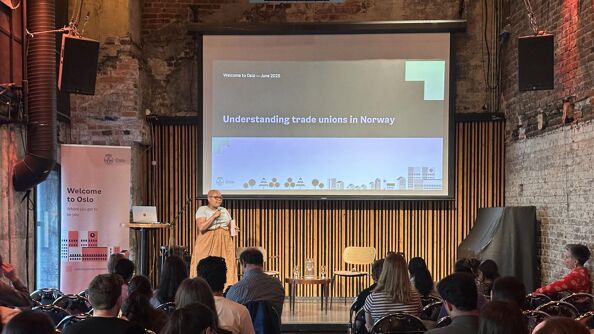
Understanding trade unions in Norway
Unions, collective agreements, and trepartssamarbeid... These are all part of what makes the Norwegian workplace fair, stable, and cooperative.
What is a trade union?
A trade union is an organization for employees. Its purpose is to protect workers’ rights and promote their interests in the workplace. In Norway, trade unions are typically organized by profession or industry, such as healthcare, education, or technology.
Trade unions hold a key role in the Norwegian model of society, and are an integral part of the country's social model.
Being a member of a union means you have support when it comes to salary negotiations, workplace challenges, and legal matters. It also means you are part of a broader system that works to improve conditions for workers across society.
What do unions in Norway do?
Unions operate at both the societal and individual level. Wages, benefits, and working conditions are achieved through collective bargaining agreements negotiated by unions. They also work to ensure workers' rights are respected, and that employers provide safe and healthy working environments.
In addition to bargaining for better working conditions, unions in Norway are also actively involved in policy-making and advocacy efforts. They participate in public debates on issues related to employment, social welfare, and the economy, and work to influence government policies to benefit workers and their families.
Union members have access to various services and benefits, such as legal assistance, job training, and social and cultural activities.
At the societal level, unions:
- Work with the government and employers to shape fair labor laws.
- Advocate for better working conditions across entire industries.
- Participate in tripartite cooperation (trepartssamarbeid), a Norwegian model where unions, employers, and the government collaborate to make decisions.
At the individual level, unions:
- Help employees communicate with their employer.
- Support members during salary negotiations.
- Assist with workplace issues such as unfair treatment or unsafe conditions.
- Provide legal assistance when needed.
- Offer access to discounts on services like insurance and banking.
- Ensure that membership fees are tax-deductible (up to 8,250 NOK in 2025).
It is important to note that if your union goes on strike, you are expected to participate. However, you will receive financial compensation during the strike period.
How unions are structured in Norway
Norway has four main union confederations, known in Norwegian as hovedsammenslutninger. These are umbrella organizations made up of many smaller individual unions (forbund).
- LO – 1,000,000 members, 23 unions
- Unio – 400,000 members, 14 unions
- Akademikerne – 265,000 members, 13 unions
- YS – 240,000 members, 11 unions
For example, the Norwegian Union of Commerce and Office Employees is part of LO, while the Norwegian Nurses Organisation is part of Unio.
How can you choose a union to join?
If you are interested in joining a union, it is a good idea to research the different unions available in your area, which unions represent your field or industry, or that have existing agreements with your company, and to consider which one best represents your interests and needs. You can visit their national websites, but many will also have a local union branch that you can contact. You should also speak to colleagues, friends, and others in your industry for advice.
Union membership in Norway is voluntary.
Employers in Norway are also organized
Just as employees have unions, employers are often part of associations. The largest of these is NHO (The Confederation of Norwegian Enterprise), which includes 18 different employer associations and over 33,000 member companies.
Approximately 70 percent of private sector employees in Norway work for a company that belongs to an employers’ association. However, only about 50 percent of employees are union members.
Even if you are not in a union, your company may still follow a collective agreement. This is a contract negotiated between unions and employers that sets standards for wages, working hours, and other conditions.
Tripartite cooperation in practice
In Norway, many issues that affect working life (such as social security benefits and working conditions) are negotiated between the government and labor organizations. This system is known as tripartite cooperation (trepartssamarbeid), and it involves collaboration between the government, unions, and employers.
One example of this cooperation in practice is the annual work of the Technical Calculations Committee (Teknisk beregningsutvalg, or TBU). This group includes representatives from:
- Statistics Norway (SSB)
- Trade unions
- Employers
- Government ministries
Each year, TBU publishes a report on the state of the Norwegian economy. This report provides neutral, fact-based information that both sides use to begin the wage settlement process (lønnsoppgjøret).
Wage negotiations in Norway take place in two stages:
- National-level negotiations in the spring: These begin with export industries, which help set the tone for the rest of the country. Negotiations then continue with the private sector, public sector, Oslo municipality, and non-governmental organizations.
- Local-level negotiations in the autumn: These take place at individual workplaces and are based on the limits agreed upon during the spring negotiations.
Only unions can negotiate on behalf of workers. If you are not a union member, your employer determines your terms and conditions independently.
Why this system matters
Norway’s model for wage negotiations and labor relations is designed to be calm, cooperative, and based on facts rather than conflict. It helps ensure that working life is fair and predictable for both employees and employers.
As of 2020, approximately 1.9 million people in Norway were members of a trade union. From the industrial revolution to today, unions have played a key role in shaping a more equal and secure working environment.