Getting around Oslo
Discover how to get around Oslo with ease. This guide covers public transport, cycling, driving, car sharing, and airport access for anyone living in Oslo.
For many years there has been a focused effort in Oslo to increase the use of public transportation, in favor of private cars.
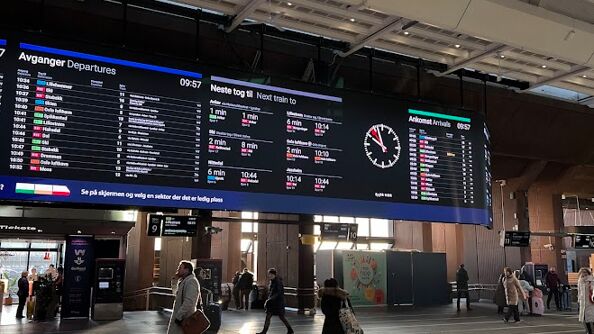
Oslo’s excellent public transportation system Ruter, makes it very easy to travel around the city. The goal is for as many people as possible to walk, cycle, and/or use public transport!
Whether you're a student commuting to university or a professional heading to work, Oslo’s public transport system makes daily travel simple and sustainable.
Public transport
Oslo city public transportation: Ruter
Provides tickets and schedules for all public transport within Oslo. Find trams (trikk), subways (T-bane), ferries (ferge), local trains (lokaltog) and busses (buss) on the website or in the Ruter app. You can also buy travelcards and tickets in some kiosks (such as Narvesen, 7-Eleven, Deli de Luca, and Mix).
- Go to ruter.no for tickets and travel times.
Public transportation in the Oslo area: Vy
If you want to travel beyond the Oslo area, you can buy tickets to long distance trains and busses through Vy. They also have a pool of electric cars to rent. You can buy tickets and book a car in the app.
- Go to vy.no for travel times and tickets.
Travel around Norway: Entur
Different cities in Norway have their own public transportation systems, such as Oslo has Ruter. Entur finds journeys across all transport options in all cities in Norway. The goal is to make it easier to choose public transport for travels.
- Go to entur.no to explore your travel options across Norway.
- Go to visitnorway.com for information about travelling around Norway.
Long distance busses
- Go to kollektivterminaler.no to see the bus companies operating from Oslo Bus Terminal (Oslo Bussterminal) (in Norwegian).
Airports
Oslo has two airports. Gardemoen Airport (OSL) is located around 40 minutes from Oslo Central Station and is reachable with Oslo local public transportation, while Torp Airport (TRF) is located 2 hours from Oslo Central Station and requires a train or bus.
Private transport
Bicycles
In addition to public transportation, it is easy to get around Oslo on a bicycle. There is a continued effort to make Oslo as bicycle friendly as possible.
Bicycles can be rented in several places, including Oslo City Bikes ("Oslo Bysykkel"). These bikes can be found at 270 stations in and around the city centre. Oslo has bike paths all over the city, making it easy to get around.
- See oslobysykkel.no for a station map and more information about rental.
- See here for a map of cycle paths in Oslo (in Norwegian).
Maps for cycling can also be found at Oslo Visitor Centre or in many public libraries around Oslo.
- Visit the City of Oslo’s information about bicycle trails (sykkelkart), bike hotels, city bikes (Oslo bysykkel), & more (in Norwegian).
- Go to University of Oslo (UiO) for information about Norwegian bicycle rules.
Find bicycle trails and trips:
- Go to Google Maps to see all the bicycle routes in Oslo.
- Go to Visit Oslo’s information about biking in Oslo.
- Go to VisitNorway’s information about experiencing Oslo by bike.
- Biking is a great way to explore Oslo's outdoors.
Privately owned cars
The Norwegian Public Roads Administration (Statens vegvesenet) has information about traffic rules, driving licences and everything to do with roads and cars in Norway.
Important: Check if your licence is valid in Norway! This is especially important for newcomers.
- Driving licences from EU/EEA countries are valid, so look into the rules for exchanging them for a Norwegian driving licence. It is an easy process where you fill out a form and use your original driving licence.
- Driving licences from EU/EEA countries must exchanged for a Norwegian driving licence within 12 months. Please note that only a few countries are elligeble for an exchange, proven you pass a new practical driving test, and in some cases also a theory test.
- Further information about exchanging driving licences from the Norwegian Public Roads Administration (vegvesen.no)
Go to The City of Oslo’s information about:
- street, transport and parking.
- street, transport and parking (more extensive information in Norwegian).
- charging electric vehicles.
Keywords in Norwegian to guide your research about driving in Oslo:
- parkeringsavgifter (parking fees)
- handikapparkering (handicap parking)
- beboerparkering (parking in your neighborhood inside ring road 3)
- veiavgift (road tax)
- piggdekkavgift (studded car tyre fee)
- bomring, bomstasjon (toll roads, toll station)
- elbil (electric car)
- hybridbil (hybrid cars)
- ladestasjon (charging station)
Other helpful links:
- Go to autopass.no for information about automated road and ferry tolls.
- Find the owner of a vehicle at vegvesen.no.
- Go to norden.org for information about driving licenses, customs and owning a car in Norway.
Other local transport options
Carpools and car sharing
There are several options if you need to rent a car for a shorter or longer period of time. You have ordinary car rentals, but you also have various carpools, or car sharing systems. The City of Oslo has dedicated parking spaces for car sharing services. Most of these services allow you to open the car through an app so you don’t have to pick up a key.
Keywords in Norwegian:
- Bildeling (car sharing)
- Bilpool (carpool)
- Billeie, leie bil (car rental, rent a car)
Here are some car sharing options in Oslo:
- Getaround: Rent a car from a private person, cars can be found all over Norway.
- Bilkollektivet: A collective where all the cars are owned by the members. You have to be a member to rent cars.
- Hertz BilPool: Short and long term var hire.
- Hyre: Short and long term var hire.
Taxies
There are several taxi companies operating in Oslo. Prices vary somewhat between the companies, and charges go up at evening and night.
Keywords in Norwegian:
- Taxi, Drosje (taxi)
Electric scooters (elsparkesykkel)
You can rent electric scooters from many providers. You get access to these through the individual providers’ apps. The same rules apply for electric scooters as for ordinary push bikes.